The Hawai‘i Department of Agriculture and Biosecurity (DAB) is reminding travelers attending this year’s Merrie Monarch Festival that quarantine restrictions remain on the transport of ʻōhiʻa from Hawai‘i Island due to the fungal plant disease, rapid ʻōhiʻa death (ROD).
The quarantine has been in place since 2015 and restricts the movement of ʻōhiʻa plants and plant parts, including flowers, leaves, seeds, stems, twigs, cuttings, untreated wood, logs, mulch, green waste and frass (sawdust from boring insects) and any soil from Hawai`i Island. Even if the ʻōhiʻa originated from another island, it may not be transported off of the island. Transport of such items is only allowed with a permit issued by the DAB Plant Quarantine Branch (PQB).
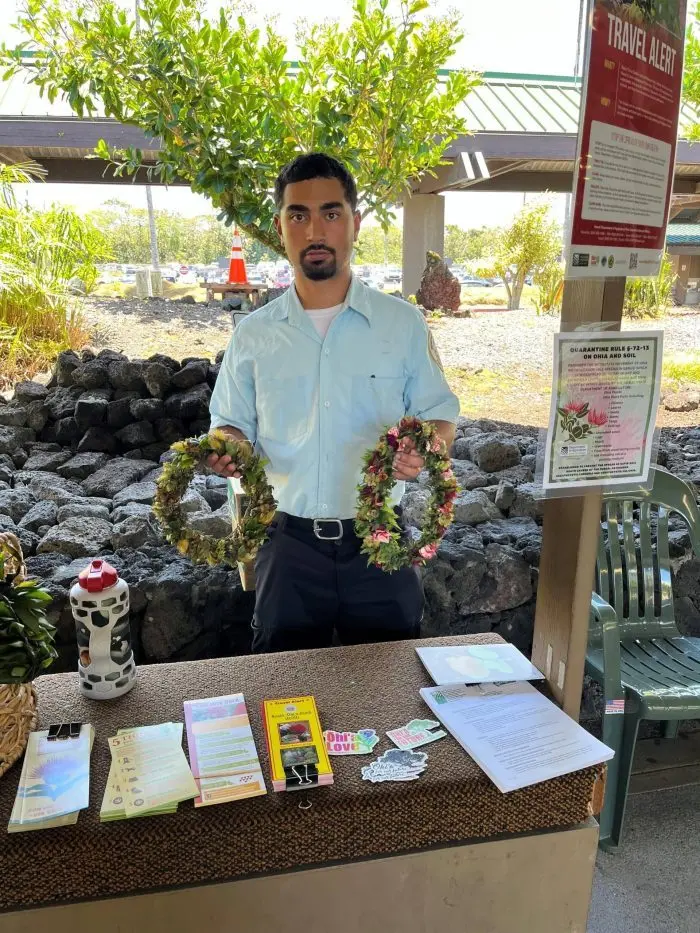
PQB inspectors will be stationed at airports in Hilo and Kona on Sunday and Monday, April 12 and 13, to collect any ʻōhiʻa material, which will be respectfully returned to the native forests on Hawai‘i Island.
At the event, the University of Hawai‘i at Mānoa, College of Tropical Agriculture and Human Resilience will provide hoʻihoʻi baskets to collect any ʻōhiʻa. Baskets will also be stationed at the Hilo and Kona airport PQB offices.
A travel alert flyer has been posted on the DAB website at: https://dab.hawaii.gov/wp-content/uploads/2015/06/ROD-Travel-Alert-Sign-12x18_09_FINAL.pdf
ROD was first noticed in 2010 in Puna. In 2014, the fungus was initially identified as Ceratocystis fimbriata by researchers at the U.S. Department of Agriculture Daniel K. Inouye Agricultural Research Service. Recent research has reclassified Ceratocystis fimbriata into two distinct species that are new to science, Ceratocystis lukuohia and Ceratocystis huliohia. It is estimated that at least one million ʻōhiʻa trees have been killed by ROD just on Hawai‘i Island alone.
The disease was detected on Kauaʻi in 2018 and on O‘ahu in 2019. Also in 2019, one ʻōhiʻa tree on Maui was infected and destroyed and ROD has not been detected on the island since. It is not known how or where the disease entered the state.
More information on ROD may be found at:
- DAB website: https://dab.hawaii.gov/blog/main/rapidohiadeath/
- UH College of Tropical Agriculture and Human Resilience website:
https://cms.ctahr.hawaii.edu/rod/
Photo credit: Department of Agriculture