
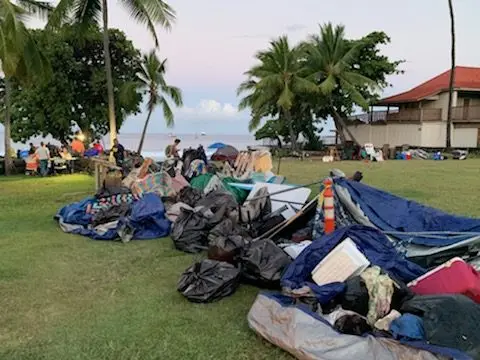
Nearly four years ago, the Hawaiʻi County Council tackled the local homeless population problem in a big way, earmarking the first funding of what would become $33 million.
The results have been disappointing, and council support for the effort seems to be eroding. Last month a new request for another $6 million for outreach and other homeless programs barely made it through on a 5-4 council vote.
“I’m here pondering,” said Puna council member Ashley Kierkiewicz during a discussion of the latest round of homelessness funding. “Has the tens of millions of dollars that Hawaiʻi County has invested in this program, have we actually made a dent? Are we better off as a community?”
“Because when I’m outside and I’m walking through communities of downtown Pāhoa and downtown Hilo, it doesn’t look like we’re better off,” she said. “I have to recognize the reality of what we are seeing.”
Council member Matt Kaneali‘i-Kleinfelder, also of Puna, added that “my expectation is, when the county puts up $30 million in three years toward addressing homelessness and housing, that the results are evident. I don’t think that they are.”
Kierkiewicz and Kaneali‘i-Kleinfelder both voted against the most recent commitment of $6 million to fund nonprofits that work with the Big Island homeless population.
The council members’ views on homelessness matter because county funds for homeless programs are distributed to local nonprofits from the county’s Homelessness and Housing Fund. That fund will expire in 2027 unless the council votes to extend it.
Council member Heather Kimball, who represents the Hāmākua Coast, voted in favor of continuing the county grant funding last month but said she wants an audit to scrutinize both the details of how the county money has been spent and the effectiveness of the effort. She expects her audit proposal will come before the council later this month.
“If the public views the program as unsuccessful, if it doesn’t look like on the ground any impacts have been made spending these tens of millions of tax dollars, it is going to be harder for the council politically to free up the program,” she said.
So far, Kimball said her constituents haven’t been complaining about the county funding for homeless programs “but there is this impression the situation is getting worse.”
The audit, she said, is not meant to be punitive: “It is really just that we need the data to determine whether or not to continue this program.”
Drugs In The Parks
The county awarded $6 million to nonprofits in the latest grant cycle to handle tasks such as outreach to homeless persons, short-term housing and shelter, long-term housing, and support programs.
Another $5.14 million is budgeted for a separate package of five grants to fund the largest shelters in East and West Hawaiʻi as well as “safe space” overnight sleeping cot programs in East and West Hawaiʻi and a permanent supportive housing project in a county facility in Kona.
That package also needs council approval, and it is unclear how the members will react.
Kierkiewicz became heated during a hearing in December on the most recent round of grant awards, telling officials from the county Office of Housing and Community Development that “I don’t even know if we’re helping people who really need help.”
“There are individuals — right? — who don’t want any rules, no responsibilities, they make any kine in our parks, taking shits, doing drugs, all that paraphernalia is there,” Kierkiewicz said.
Kierkiewicz said she has accompanied park maintenance workers on their rounds, and the workers say 80% of their time is spent “cleaning up other people’s mess.”
“I get pissed off because I’m a taxpayer. I’m a mother. I cannot take my kids to the park anymore because I don’t know what kinds of crap they’re going to step on, or the kinds of people they’re going to see,” she said. “I get plenty compassion, but I also know responsibility to community.”
Kona council member Rebecca Villegas also raised concerns, saying the same nonprofits seem to receive county grants each cycle. They get “the lion’s share of funding continuing to go to them and their programs with very little impact, quite frankly, is what I’m frustrated about.”
Brandee Menino, CEO of the homeless services provider HOPE Services Hawaiʻi, told Civil Beat she is approached at times by people frustrated that the homeless problem doesn’t seem to be getting better.
“It’s getting worse, for sure,” said Menino, who has worked in social services on the island for 24 years. With all of the changes at the federal level posing new threats to federal funding for Medicaid, food subsidies and federal housing subsidies, she said, “It’s going to get worse.”
But Menino said the county should continue the Homelessness and Housing Fund.
She cited figures from Bridging the Gap Hawaiʻi that show HOPE Services and other social service agencies helped 552 people transition from homelessness to permanent housing on the Big Island last fiscal year.
“Our data shows that 74% of the people that we touch are going into housing,” Menino said. “People are staying housed when there’s support.”
“While we’re doing a rock-star job at exiting people (from homelessness) and securing housing, acquiring housing, leasing housing — we’re doing amazing — what the data also shows is more people are falling into homelessness,” Menino said.
Menino cited county data showing that 80% of the homeless say they would come indoors if there were housing or shelter available. “We just don’t have the housing that people can afford,” she said.
Almost half of the people moving from homelessness into housing can only do so because they receive housing subsidies, she said.
“You need the subsidies, you need the housing inventory,” Menino said. “That’s the bottleneck.”
Struggling Nonprofits
Staff with the community development office sent the council reports that show they are trying to address members’ concerns, including an increased focus on grants for essential services such as emergency shelters.
They say the county also is distributing the grants in ways that target more Big Island communities, and spreading the money around to more nonprofits.
But Kēhaulani Costa, the community development administrator, told council members she has seen the nonprofits struggle when their funding is cut.
The county reduced or eliminated some grants this year to fund others, and when awardees lost funding, “we’ve seen emergency shelter beds reduced, we’re going to see outreach programs reduced because funding was not available,” Costa said.
The county hired a consultant in 2024 to evaluate the work of the Homelessness and Housing Fund, and the consultant’s report cited the lack of “truly affordable housing” on the Big Island. It opined the fund must be considered one piece of a larger, countywide strategy.
“Given the long term nature of the homelessness crisis, building a sustainable infrastructure and expanding the capacity of county and non-profit-providers must be a priority,” according to consultant SAS Services.
It proposed creating a new Office of Homelessness to coordinate services, and suggested the fund continue after 2027 as a “flexible funding mechanism to address the growing needs in the areas of homelessness and housing instability.”
But given the obvious unhappiness on the council, that may not be the direction the county is headed.
“This process that we have for the HHF, at some point it’s going to die out,” Kierkiewicz said. “We never designed this to be a permanent entitlement. It was always temporary in nature.”
Council member Dennis “Fresh” Onishi, who represents Hilo and part of Puna, told his colleagues last month he is willing to support social service programs, “but they have to have a timeline of when they’re going to stop getting money from the county.” Onishi was among the five who voted in favor of the $6 million allocation.
They need to find their own resources to continue operations, and “that’s what I don’t see,” he said.
And Kaneali‘i-Kleinfelder cited reports that California has spent $24 billion in five years trying to address homelessness, yet homelessness has increased there, too.
“I am concerned about throwing money at an issue that we’re not able to fix,” he said. “There has to be an outcome to spending $30 million in taxpayer funds, or we’re in a bad spot.”
Story originally published by Honolulu Civil Beat and distributed through a partnership with The Associated Press.
Photo credit: Hawaiʻi County Mayor’s Office